Hôtels particuliers
Hôtel de Lamoignon and Paris’s first giant pilasters
Built for Diane de France, the house carries hunting emblems above colossal pilasters, among the earliest of their kind in Paris.
- Arrondissement
- 4e
- Métro
- Saint-Paul
- Period
- 1584-1660s
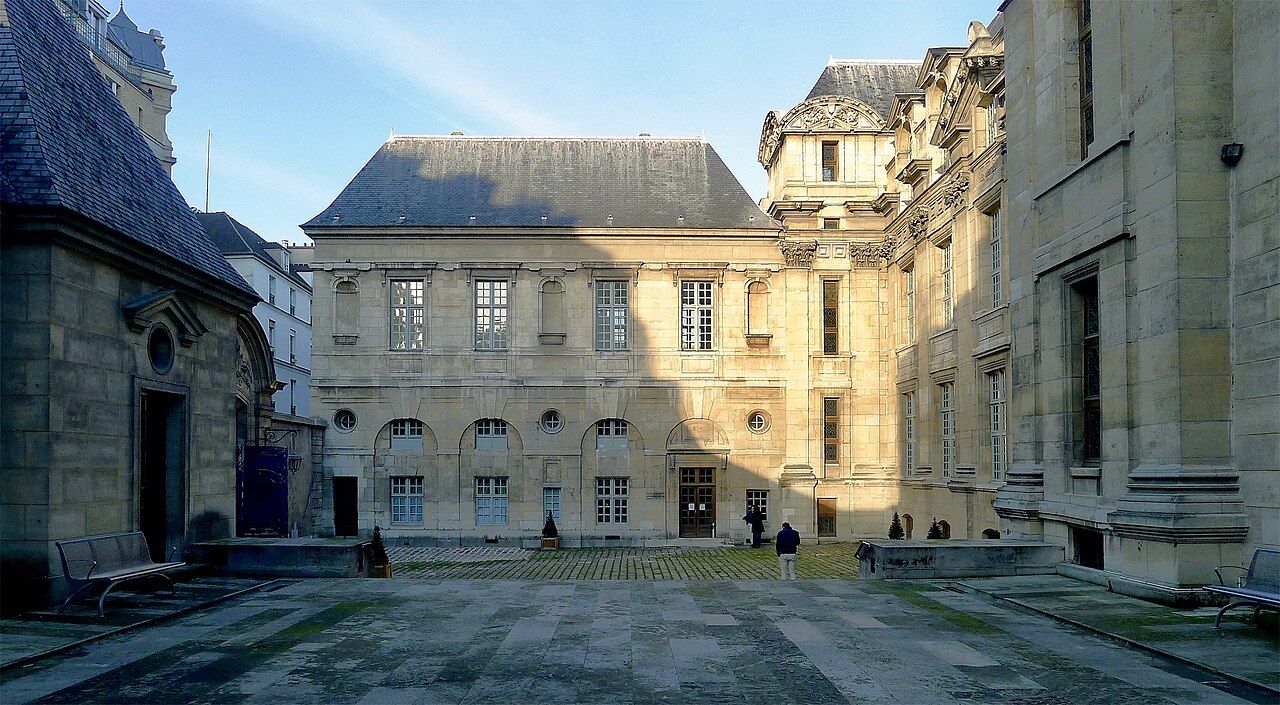
“Colossal Corinthian pilasters.” Morning begins with the façade’s largest gesture. At 24 rue Pavée, the house was built from 1584 for Diane de France, legitimated daughter of Henri II. Rue Pavée refers to its early paving, unusual in medieval Paris. The street’s name offers a brief prelude, but the façade quickly takes over.
The pilasters rise through two storeys, among the earliest of their kind in Paris. Their scale makes the façade feel less like a quiet backdrop than a declaration. The stone’s repeated vertical lines hold the eye before the carved details. The pediments carry bows, quivers and stag heads, hunting emblems that allude to the goddess Diana. Diane’s name and the goddess’s signs meet above the street.
As the day moves on, the house’s other name enters the story. Guillaume de Lamoignon, first president of the Parlement of Paris, lived here from 1658. He received writers such as Racine and Boileau in the house. The façade’s carved hunt stands beside a quieter history of reading and conversation.
By afternoon, the house belongs to the city in another sense. The City of Paris bought it in 1928. Since 1969, it has held the Bibliothèque historique de la Ville de Paris. Books, maps, prints and photographs gather here around the city’s history. The collection shifts the day’s attention from stone to paper.
That history keeps company with nearby streets and buildings. The street also holds an Art Nouveau synagogue a few doors away, another architectural note. The house also sits within a city that has made its own past visible, including through the city's museum of its own history.
Evening leaves the façade’s emblems in place: bows, quivers, stag heads. Each emblem keeps the hunt present without turning it into a scene. The pilasters still make a large claim, though the house now holds a library. Perhaps the day’s question is simple: what else can a façade preserve?