Hôtels particuliers
How did Hôtel de Beauvais make room for a curve?
An irregular plot became an asymmetric courtyard with a curved end, while a balcony and Gothic cellars hold the house’s layered history.
- Arrondissement
- 4e
- Métro
- Saint-Paul
- Period
- 1655-1660
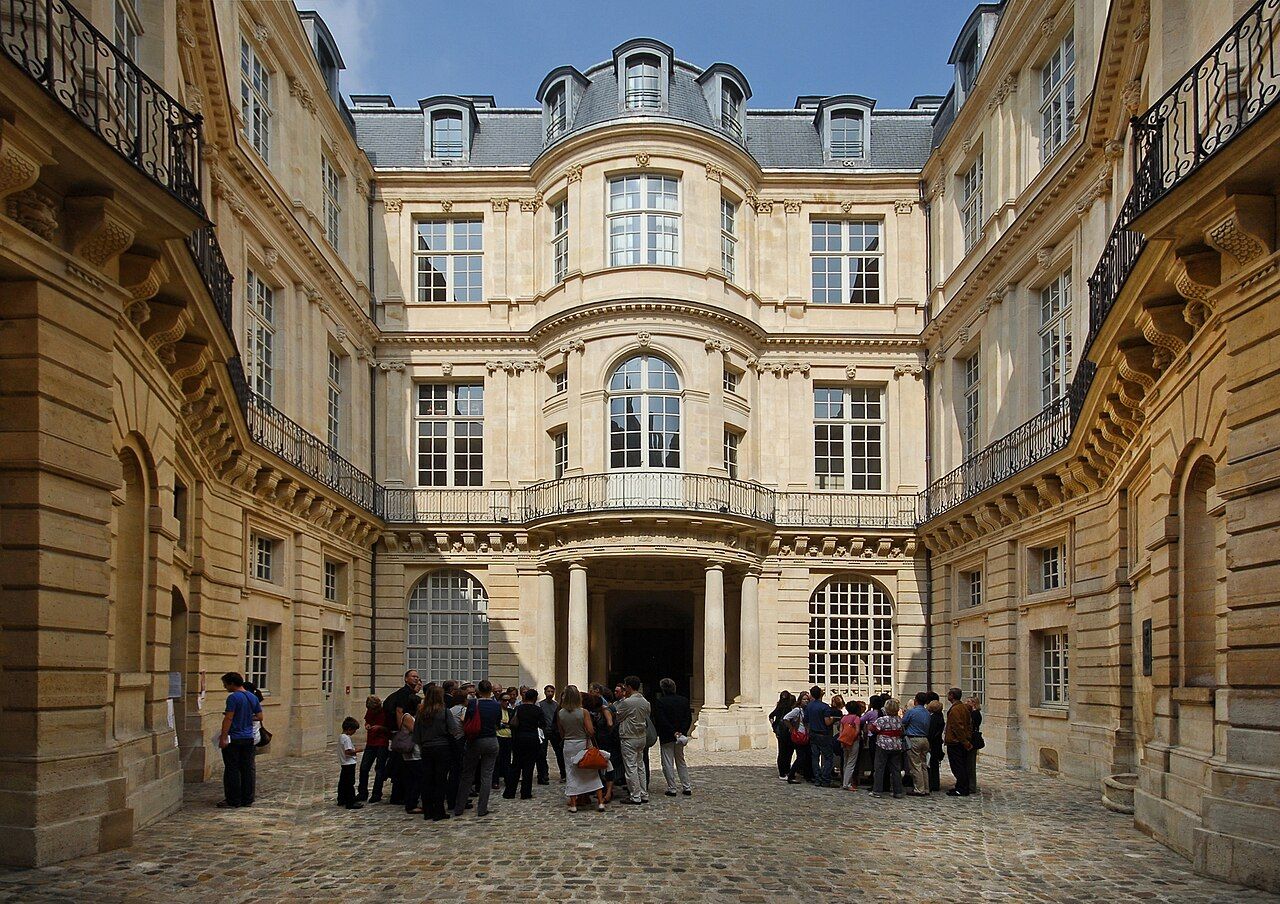
1655–1660: Begin with the plot, not imagined symmetry. At 68 rue François-Miron, the site was irregular. That awkward ground became the architectural question. Antoine Le Pautre built the house for Catherine Bellier, first lady of the bedchamber to Anne of Austria. Against the half-timbered fronts down the street, the house’s problem comes sharply into view.
Follow the answer into the courtyard. Le Pautre made it asymmetric, then curved its end. The curve does not disguise the awkward plot. It gives the irregular outline a clear interior logic. Straightness might have been easier to picture. Instead, the courtyard lets constraint shape the composition. The curve makes the awkward boundary legible from within the courtyard itself. Read the bend slowly; it is the house’s argument.
Look toward the balcony, where the house met royal history. On 26 August 1660, Anne of Austria watched the entry of Louis XIV and Maria Theresa into Paris. That scene gives the balcony a precise role. A private house faced a public arrival. This belongs to the quarter at its 17th-century height, where architecture and ceremony share the same frame.
Move from ceremony to the house’s later guests. The Mozart family lodged here in 1763 and 1764. Wolfgang Amadeus was seven during those stays. A child’s lodging sits beside the scale of royal arrival. Below, Gothic cellars survive from an earlier house. That house belonged to the abbey of Chaalis. One recalls a family’s stay; the other, an earlier layer beneath the building.
Finish with the building’s present purpose. It is now the seat of the Administrative Court of Appeal of Paris. It is also a classified historic monument. The house has shifted from courtly residence to civic work. Its curved end still keeps the original problem visible. At the courtyard’s bend, constraint becomes the lasting shape.