Streets & squares
Rue Vieille-du-Temple, five centuries at a corner
From the old road to the Templars’ enclosure to a turret restored after war, the street keeps distinct centuries close along one pavement.
- Arrondissement
- 3e and 4e
- Métro
- Saint-Paul
- Period
- 13th-18th century
What does morning reveal?
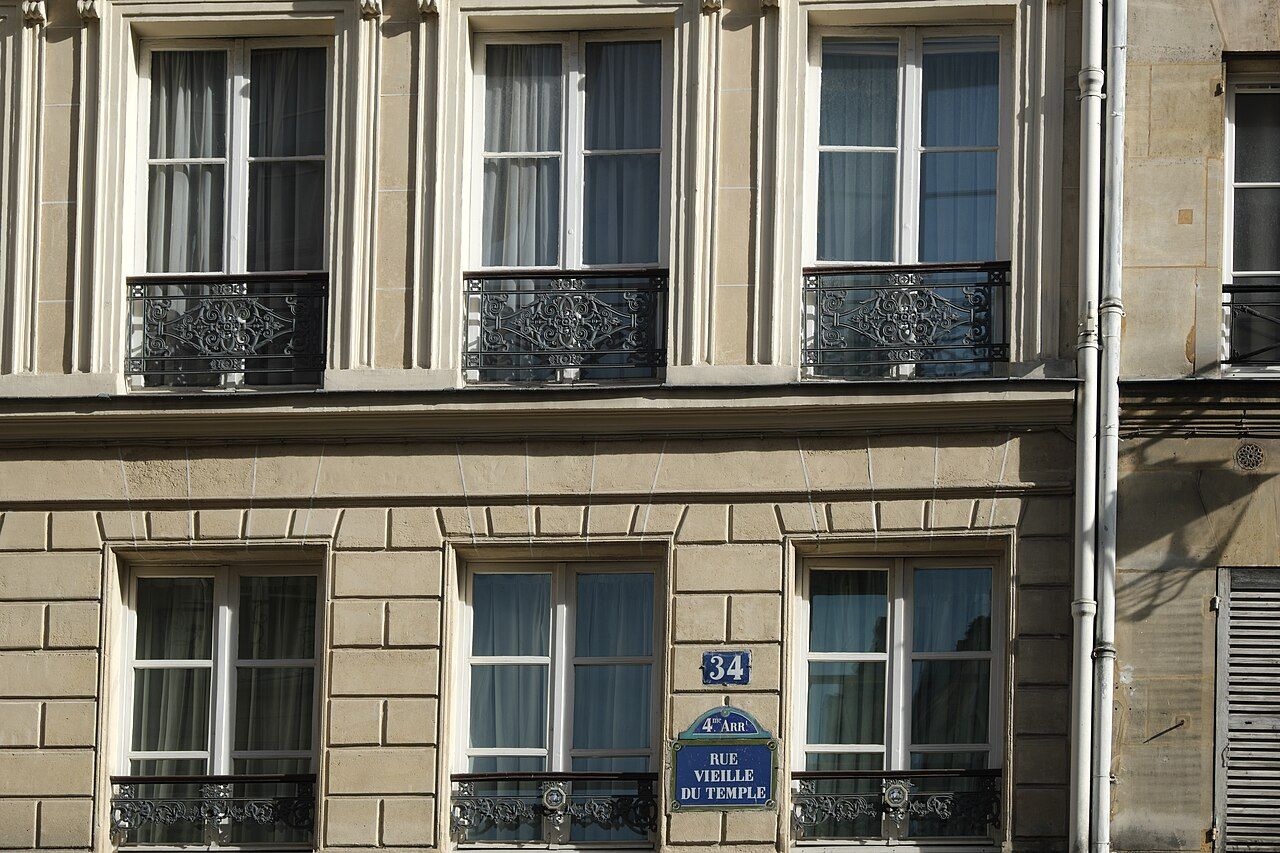
1510 places a precise hinge in Rue Vieille-du-Temple. Morning starts at rue de Rivoli, where the street runs north. It crosses the Marais and continues into the 3rd arrondissement. Its name recalls the old road from the city to the Templars' walled enclave. The street’s name holds a route older than its present corners. Along one pavement, history arrives in different registers.
The southern stretch crosses rue des Rosiers, in the heart of the old Jewish quarter. A crossing can carry more than traffic; here, it carries a neighbourhood’s history. The street keeps moving north, while its name looks back toward the fortified enclosure. The distance between those two directions gives the route its particular tension.
What gathers at midday?
At rue des Francs-Bourgeois, the crossing marks the line between the 4th and 3rd arrondissements. The Hôtel Hérouet stands at this corner, its corbelled turret projecting above the street. Built around 1510 for Jean Hérouet, treasurer to Louis XII, it gives the corner a strong Renaissance profile. The turret makes the past feel close, not carefully set apart. The busiest corner becomes a place where several periods meet.
That outline carries damage as well as age. In August 1944, a German bomb badly damaged the turret. It was restored after the war, adding repair to its long history. The stone shape remains an image of survival, though not an untouched one. Its presence gives the crossing more weight than a simple change of arrondissement.
What remains by late afternoon?
At No. 47, the house where Figaro was written is the Hôtel Amelot de Bisseuil, a mansion of the 1650s. Its name brings another century into the street’s close procession. No. 87 holds the Hôtel de Rohan, built for a prince-bishop of Strasbourg. It is now part of the national archives. The street’s past does not settle into one period; it keeps changing its terms.
Late afternoon gathers these fragments into a single walk: old road, quarter, turret, mansions. The hours do not smooth their differences. They make the contrasts easier to read, corner by corner. At the Francs-Bourgeois crossing, the turret holds its place above the pavement. The street continues north, carrying its older name onward.