Edges & walks
How does Paris fit beneath one glass roof?
A hall built for paintings becomes a lens on Paris, with the central city gathered beneath glass and iron.
- Arrondissement
- 4e
- Métro
- Sully-Morland
- Period
- 1879; centre 1988
“A large scale model of central Paris is shown in the main hall.”
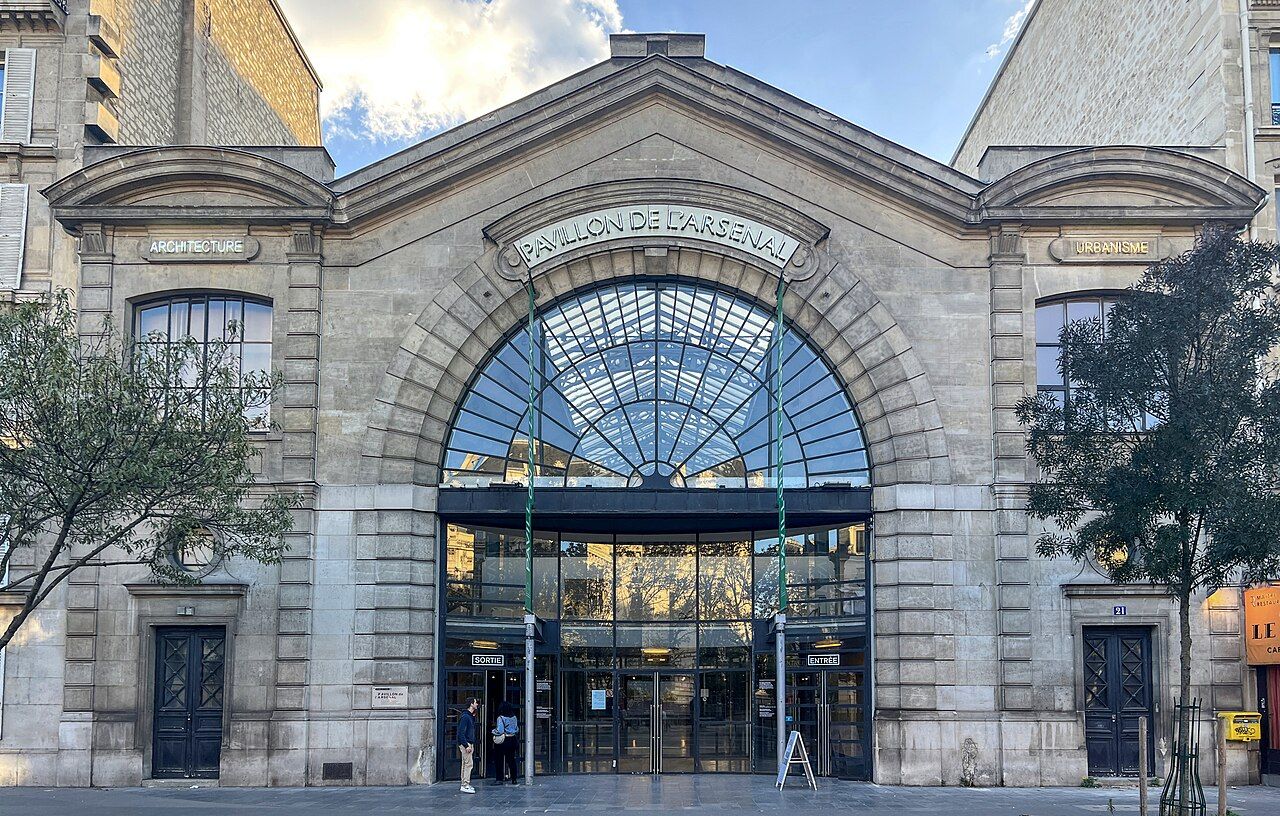
Morning begins with a hall designed to put paintings on display. The Pavillon de l'Arsenal was built in 1878-1879 for Laurent-Louis Borniche. He was a timber merchant who wanted a hall for paintings. Its main hall is lit by a large glass roof on an iron frame. Glass and iron make the ceiling’s structure part of the room’s character.
The name the library of the old artillery carries a different civic register. Here, the old purpose gives way to another way of seeing Paris. Since 1988, the building has been the city’s centre for urban planning and architecture. Exhibitions trace the city’s growth and current architectural projects.
By midday, the central city has become the room’s subject. A large scale model gathers its streets into one view. The model gives distance a physical measure, without making the city feel settled. At its edge, Paris before Haussmann gives the city’s growth a longer frame.
Boulevard Morland holds another layer beneath its present name. It runs over the former channel that separated Île Louviers from the Right Bank. The channel was filled in 1843. The street’s line makes that changed geography briefly legible.
In the afternoon, the model and exhibitions pull the eye back indoors. One shows central Paris as a whole; the others follow change. The building links the city’s past growth with projects still taking shape. That combination feels more compelling than a static portrait.
Programmes and exhibitions are listed at pavillon-arsenal.com. The information sits alongside a building whose subjects keep moving. Its original hall held paintings; now, architecture and planning share the space.
By evening, the glass roof still frames the main hall. Beneath it, Paris rests in miniature, both map and argument. Outside, boulevard Morland crosses the line of a vanished channel. The city keeps its older shapes, even when water is gone.