Churches
What does the Billettes cloister keep?
A step-by-step reading of Paris’s only medieval cloister still standing, from its 1427 beginnings to its vaulted galleries and neighbouring church.
- Arrondissement
- 4e
- Métro
- Hôtel de Ville
- Period
- 1427
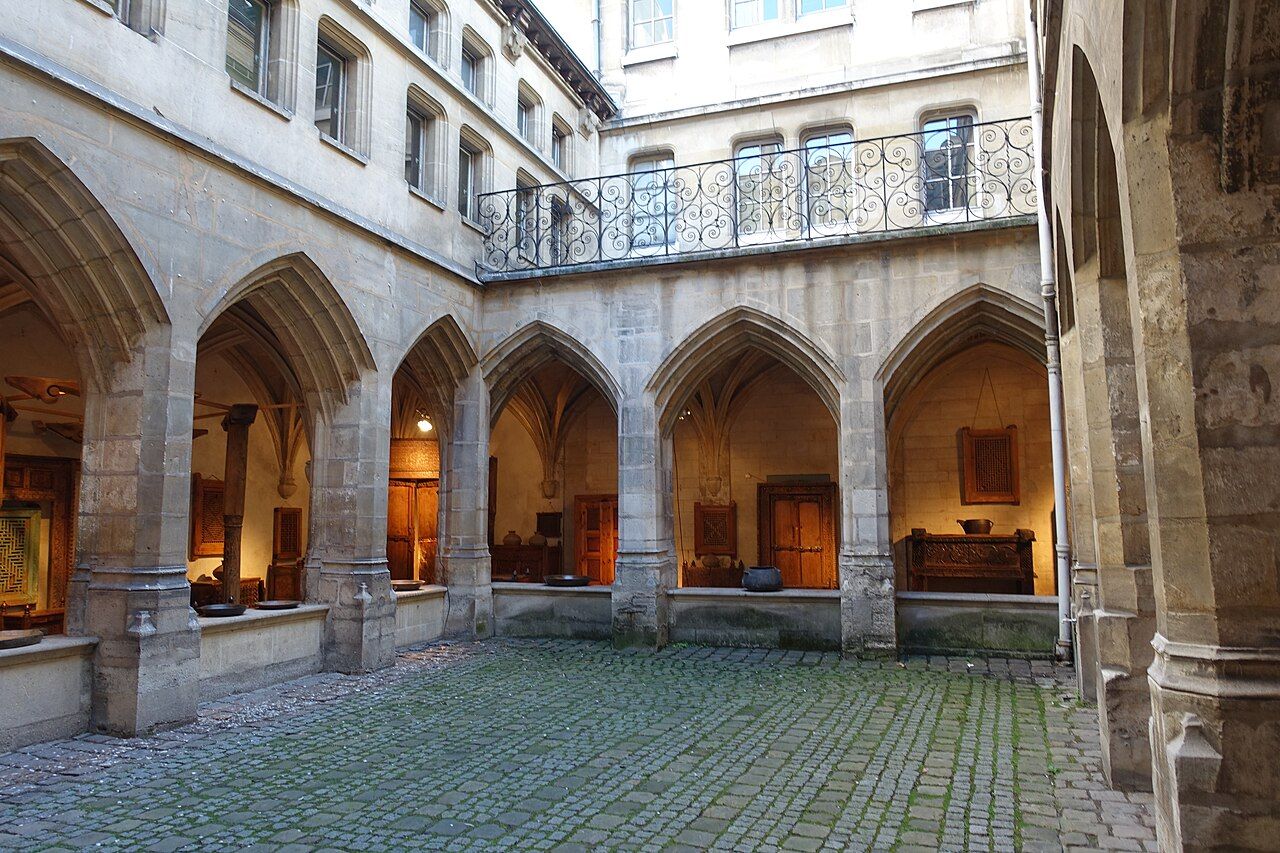
“The only medieval cloister still standing in Paris.”
How does the cloister reveal itself?
Begin with the street stitched from older lanes, then consider the address: 24 rue des Archives. The cloister is not a grand announcement. Its importance rests in the quiet fact of its survival, medieval stone still standing within Paris.
Next, hold the date beside the place. The cloister was built in 1427 for the Brothers of Charity of Our Lady. In Paris, that hospitaller order was known as the Billettes. The name carries its own small history.
Then take in the galleries as a whole. Four sides gather around the cloister, each with flamboyant Gothic rib vaults. The lines rise, meet, and divide the space into something measured. Stone gives the quiet its structure.
Look next to the church, and follow its change of use. It was rebuilt in the 1750s for Carmelite friars. Since 1812, a Lutheran congregation has used it. The neighbouring church shifts the story without erasing what came before.
The church's history sits in the same religious landscape as the church of the white cloaks. Here, the cloister and church hold different layers together. Their proximity makes the change of use feel present, not merely historical.
After the architecture, notice what the galleries hold now. Exhibitions and concerts are held in the cloister. The old structure remains a setting for gathered attention, though its stone still draws the eye first.
Finally, take the cloister as a classified historic monument. That designation belongs alongside its more particular distinction: no other medieval cloister still stands in Paris. A quiet place can carry a very large measure of time.
The sequence ends where it began, with survival. Four galleries, rib vaults, and a church beside them: the Billettes hold several histories close. What else might this quiet stone keep?