Churches
The church with a borrowed façade
A street name remembers white cloaks; the church wears a façade from the Île de la Cité and keeps its layers in view.
- Arrondissement
- 4e
- Métro
- Rambuteau
- Period
- 1685-1690
1685–1690: the present church was built on rue des Blancs-Manteaux.
What does morning remember?
Its name, however, carries an older congregation and wardrobe. The Servites of Mary settled there in 1258, wearing white cloaks. In 1297, the Guillemites replaced them, dressed in black. The order changed; the street's name did not. That stubborn name keeps two histories in one breath. The present church came later, built between 1685 and 1690. The sequence is plain; its layers are not. White cloaks gave the street a name that survived replacement. Black robes changed the occupants, not the name's memory. Names can outlast the people who first gave them meaning. Here, the street keeps the earlier order in view. The later church adds another borrowed layer to that inheritance. Its history reads less like a line than a seam. Each change remains visible beside the next. That construction makes a quiet argument for continuity. Continuity here means carrying changes, not hiding them.
What arrives by midday?
In 1863, a façade arrived from the Île de la Cité. It had belonged to the Barnabite church, demolished during Haussmann's works. The present church received it, carrying another building's face. The movement altered more than an entrance; it changed the story. A church assembled from elsewhere resists a simple beginning. Its front belongs to a city remade by the street-cutting of the 19th century. A building can carry its past openly, much like a cloister from 1427. The façade does not erase its earlier address. Instead, it holds departure and arrival in one frame.
What remains in late afternoon?
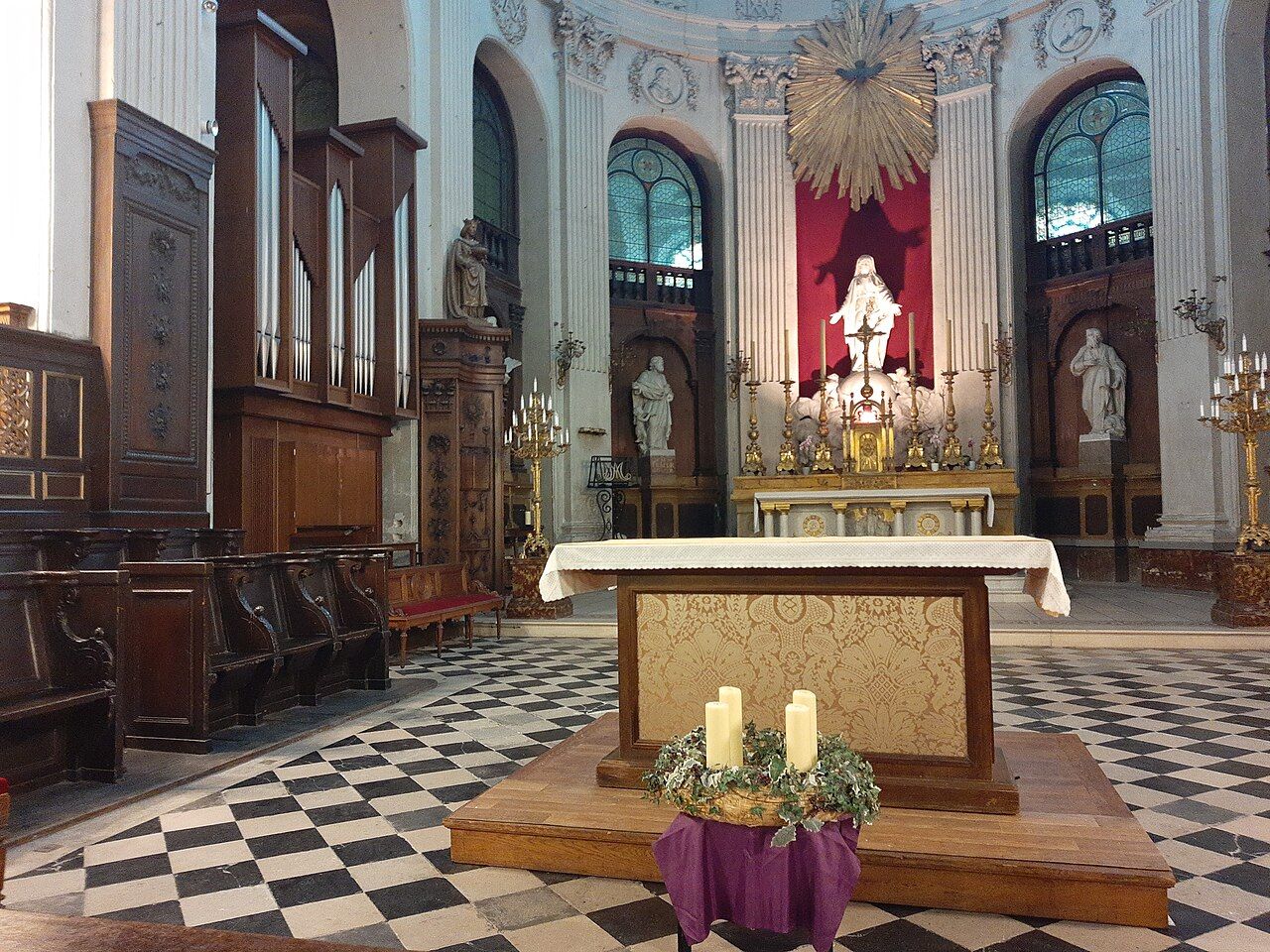
The church stands on rue des Blancs-Manteaux, close to rue Vieille-du-Temple. Even the street places the building among names inherited. The pulpit, dated 1749, shifts attention from façade to detail. Its Flemish rococo style is inlaid with ivory and pewter. Those materials make the ornament feel almost tactile. The church is known for its organ concerts. An organ gives the assembled building another kind of voice. No façade can contain the sound once it begins. Late afternoon leaves one question hanging: where does the church begin?