From marsh to Malraux
Where medieval Paris met its wall
Along rue des Jardins-Saint-Paul, two towers and a long surviving stretch make the old edge of Paris visible from the pavement.
- Arrondissement
- 4e
- Métro
- Saint-Paul
- Period
- 1190-1209
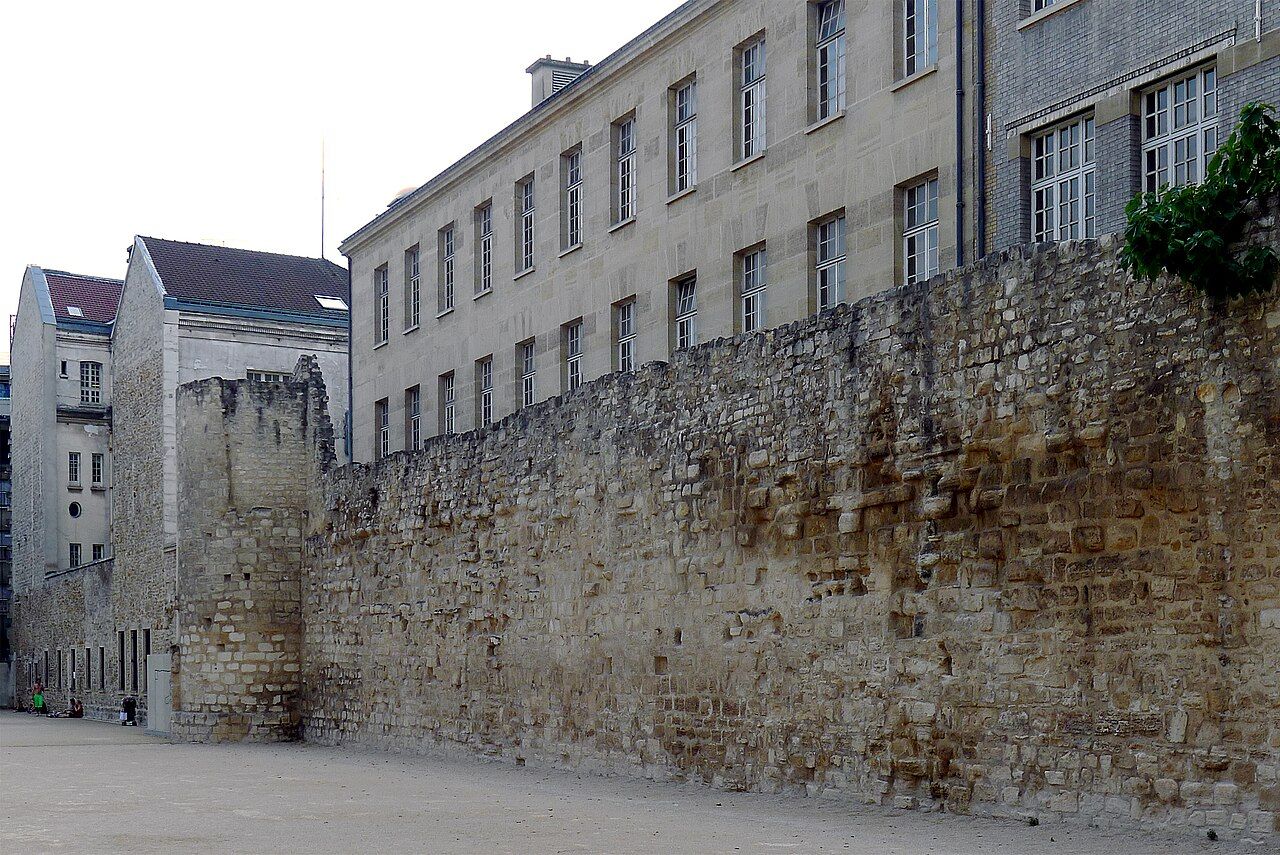
“Round towers stood at regular intervals along the wall.”
The wall first reads as a boundary, not a monument. Philip II Augustus ordered a wall around Paris in 1190. He was leaving on the Third Crusade. The order gives the stone a blunt purpose: enclosure. The whole wall ran for about 5 kilometres, on both banks. Its surviving length here makes that old edge legible from the pavement. The present street holds one piece; the mind supplies the larger circuit. Nothing needs to be reconstructed for the boundary to register. Its line still has weight, even in fragments.
Next, follow the wall’s material logic. A rubble core sat behind dressed limestone. At its base, the wall measured about 3 metres thick. That thickness is difficult to treat as mere decoration. It speaks of a structure made to stand around a city. The dressed face gives the rubble a surface; the core gives the face depth. Together, they turn a simple line into something substantial. The surviving stones make that difference clear without explanation. Their force lies partly in the contrast: a pared surface enclosing a rougher heart.
Then let the towers set the rhythm. Round towers stood at regular intervals along the wall. Two remain on the longest surviving stretch, along rue des Jardins-Saint-Paul. Their repetition belongs to the larger design, while their survival belongs to this particular stretch. The wall is not an isolated tower or a stray stone. It is a length, with the towers still marking its sequence. That continuity is the detail worth lingering over. The old boundary feels less like a relic when its parts remain joined. Nearby, the story of the king's gardens beside the wall extends that sense of a boundary with uses beyond defence.
Now take in the school ground beside the wall. The stretch on rue des Jardins-Saint-Paul borders the sports ground of the Lycée Charlemagne. That pairing keeps the old line close to ordinary present use. The wall does not need a grand setting to hold attention. Beside the ground, its height and thickness make the past feel less abstract. The pavement gives the view its plain measure: stone, towers, and an edge. A school ground presses against a structure built around Paris. The contrast is quiet, but it sharpens the scale of what remains. The wall has become part of a street’s visible grain.
Finally, read the gap between the two walls. From 1356, a new wall built under Charles V enclosed the Marais. Philip’s wall then became obsolete on the Right Bank. Many houses later rose against or on top of the old wall, hiding it for centuries. The long stretch survived where much of its line disappeared from view. The quarter’s history follows that changed boundary too: the quarter that grew along the wall's line. The old wall was overtaken, covered, and left behind, yet this length remains exposed. It offers an edge without pretending the city stopped there. What becomes of a boundary when another one moves beyond it?
The wall began as an enclosure, then became part of the fabric it bounded. Along rue des Jardins-Saint-Paul, the old line stays readable beside the pavement. Its towers give the stretch a measured cadence; its stone keeps the measure physical. The Marais grew within a later enclosure, and houses concealed parts of the earlier one. This surviving length resists that concealment. It does so without spectacle: a long wall, two towers, and the sports ground beside them. The old edge remains present, but its meaning has shifted. It now marks a boundary that Paris outgrew, while preserving the shape of that earlier limit. The story of that transformation continues in the quarter that grew along the wall's line.
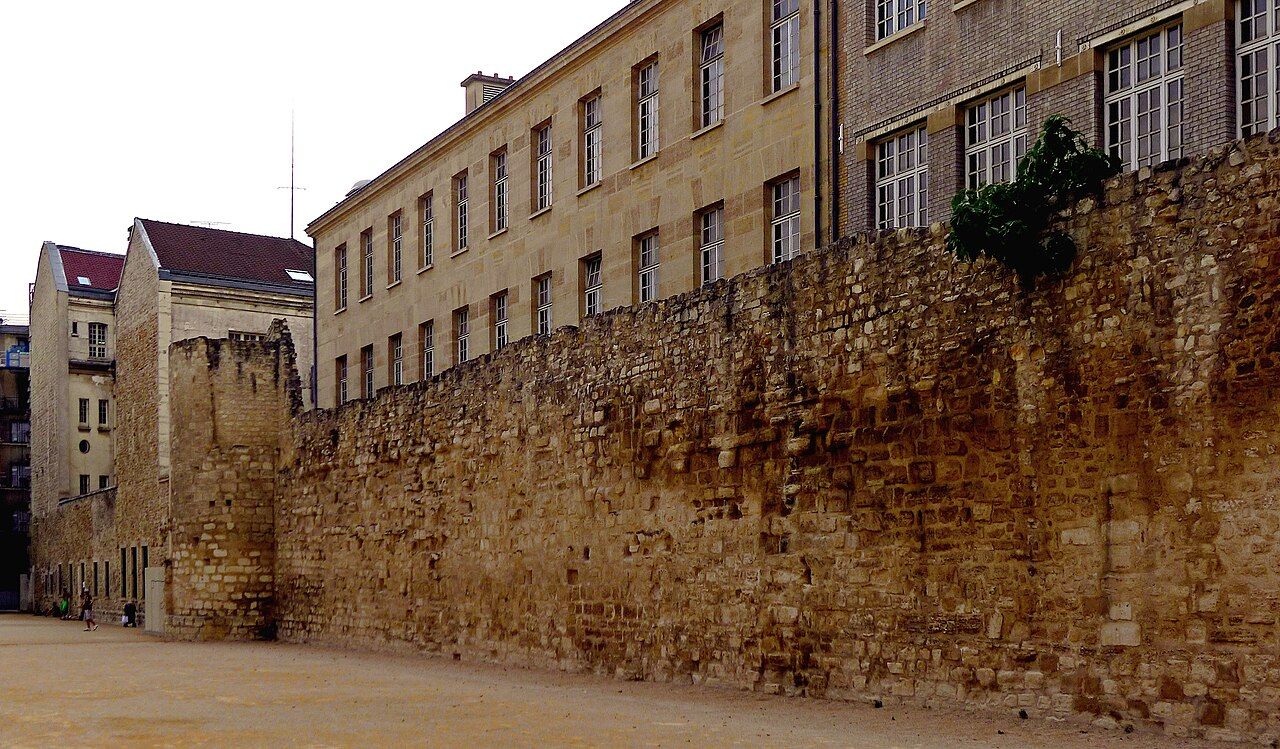
The wall’s stones offer no neat ending. They hold together defence, obsolescence, concealment, and survival. The pavement makes the old edge visible, though not complete. Its two towers keep the vanished rhythm close at hand. The surviving stretch leaves a question open: how much of a city’s past can one boundary still contain?