From marsh to Malraux
The Bastille at the eastern edge
A fortress became a prison, then rubble. Its outline still runs through the paving, while fragments and foundations hold the city’s memory in place.
- Arrondissement
- 4e (edge)
- Métro
- Bastille
- Period
- 1370-1789
Eight towers once guarded Paris at its eastern gate.
What does morning reveal?
The Bastille Saint-Antoine stood where the city met its eastern edge. Charles V built it between 1370 and 1383. Its purpose was direct: guard the eastern gate of Paris. Eight round towers joined by thick walls enclosed the fortress. A moat surrounded it, setting stone apart from street. The moat also holds the boat basin dug in the fortress moat.
That structure has disappeared, but its plan has not. The fortress survives here as an outline, not a building. Lines of paving stones trace its shape across Place de la Bastille. They continue at the start of rue Saint-Antoine. The stones make an absence legible underfoot.
The fortress survives here as an outline, not a building.
The lines do not rebuild the Bastille in the mind. They mark where towers, walls and moat once defined space. A fortress once occupied the eastern gate with deliberate weight. Now the pavement holds only its boundary. The square carries that difference plainly.
There is a particular pleasure in reading a city through marks. Here, paving makes the old footprint more than an idea. It gives the vanished fortress a form without restoring it. The stones stay quiet; the history does the speaking.
What changes by midday?
From the 17th century, the Bastille became a state prison. People were held there on royal orders. The fortress’s purpose shifted, though its walls remained. Defence gave way to confinement inside the same heavy shape.
Voltaire was imprisoned in the Bastille in 1717. His name places one person within a larger system. The prison held people by royal order, behind its thick walls. The Bastille was not merely a fortification by then. It was also an instrument of state power.
The prison's archives have a home in the library that holds the prison's archives. Stone and record offer different kinds of trace. One remains as a line in the square. The other holds the prison’s paper history.
The story reaches its rupture on 14 July 1789. The Bastille was stormed that day, with seven prisoners inside. The number is small beside the fortress’s scale. Yet the building’s meaning could not be measured by occupancy. Its walls had come to stand for royal authority.
The fortress was stormed, then emptied of its future. Demolition began the next day. The builder Pierre-François Palloy organized the work. The Bastille’s destruction became another chapter in its public life. Its disappearance was not a quiet ending.
Palloy had stones carved into models of the Bastille. He sent those models to the departments of France. A fortress reduced to pieces became portable again. The carved stones carried its shape beyond the place itself. Even demolition could not make the outline wholly vanish.
What remains by late afternoon?
The pavement lines are the clearest mark on the square. They give the fortress a footprint, not a façade. The distinction matters: the towers no longer rise here. Their outline keeps the missing structure in view.
Other remains sit apart from that traced perimeter. Foundations of one tower appeared during Métro works. In 1899, they were moved to Square Henri-Galli near the Seine. A fragment’s journey gives the fortress another address. Its stone survives, though not where it first stood.
More of the fortress wall can be seen on a platform of line 5 in Bastille station. The remains interrupt the station’s present-day purpose. A wall once joined the fortress together; now fragments appear within the Métro. The old structure meets the city in pieces.
These traces ask for a different sort of attention. Nothing here restores the eight towers or their walls. Instead, pavement, foundations and fragments hold separate parts. Together, they make the Bastille present without making it whole. The building exists today only through its outlines and remains.
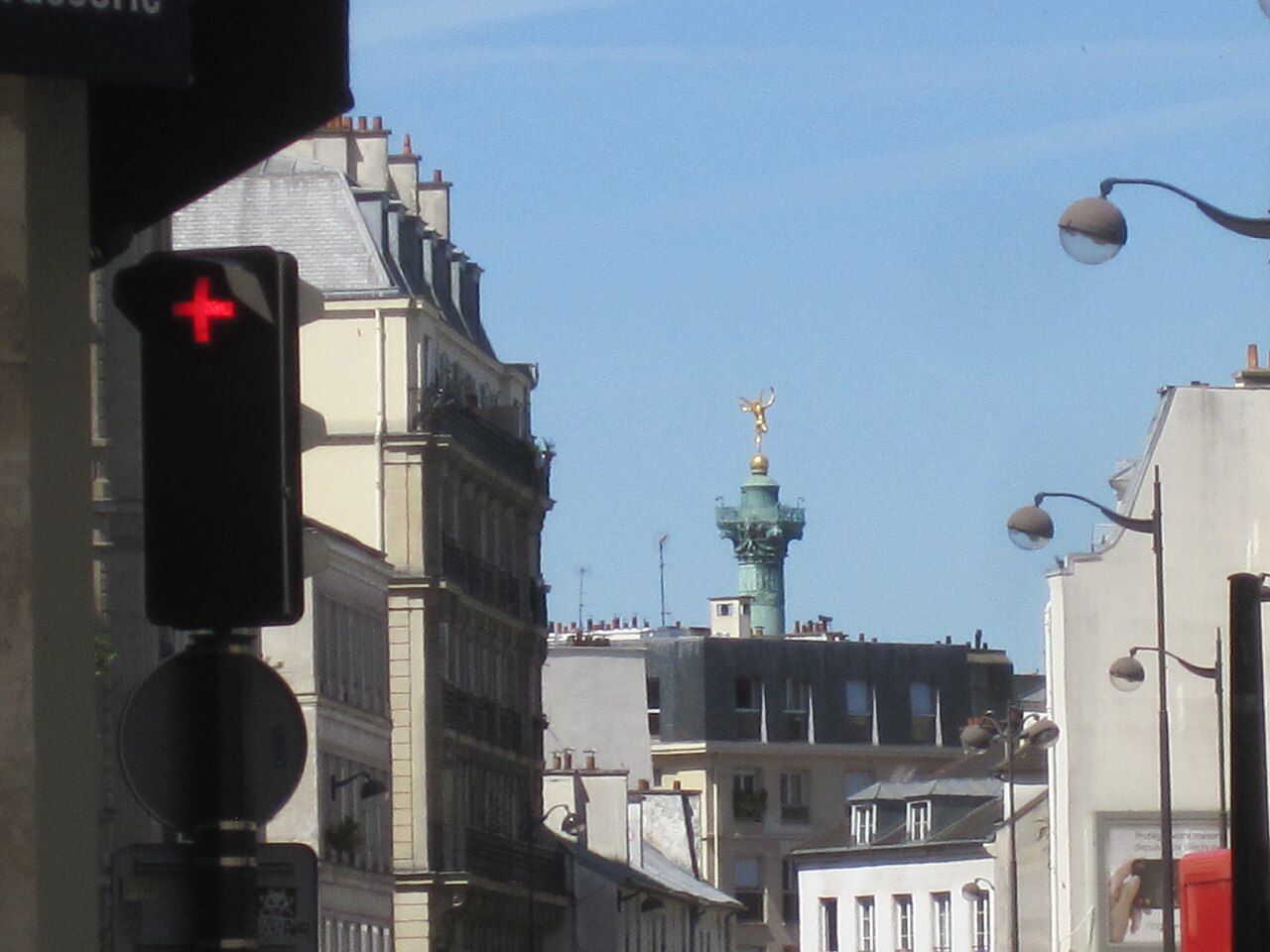
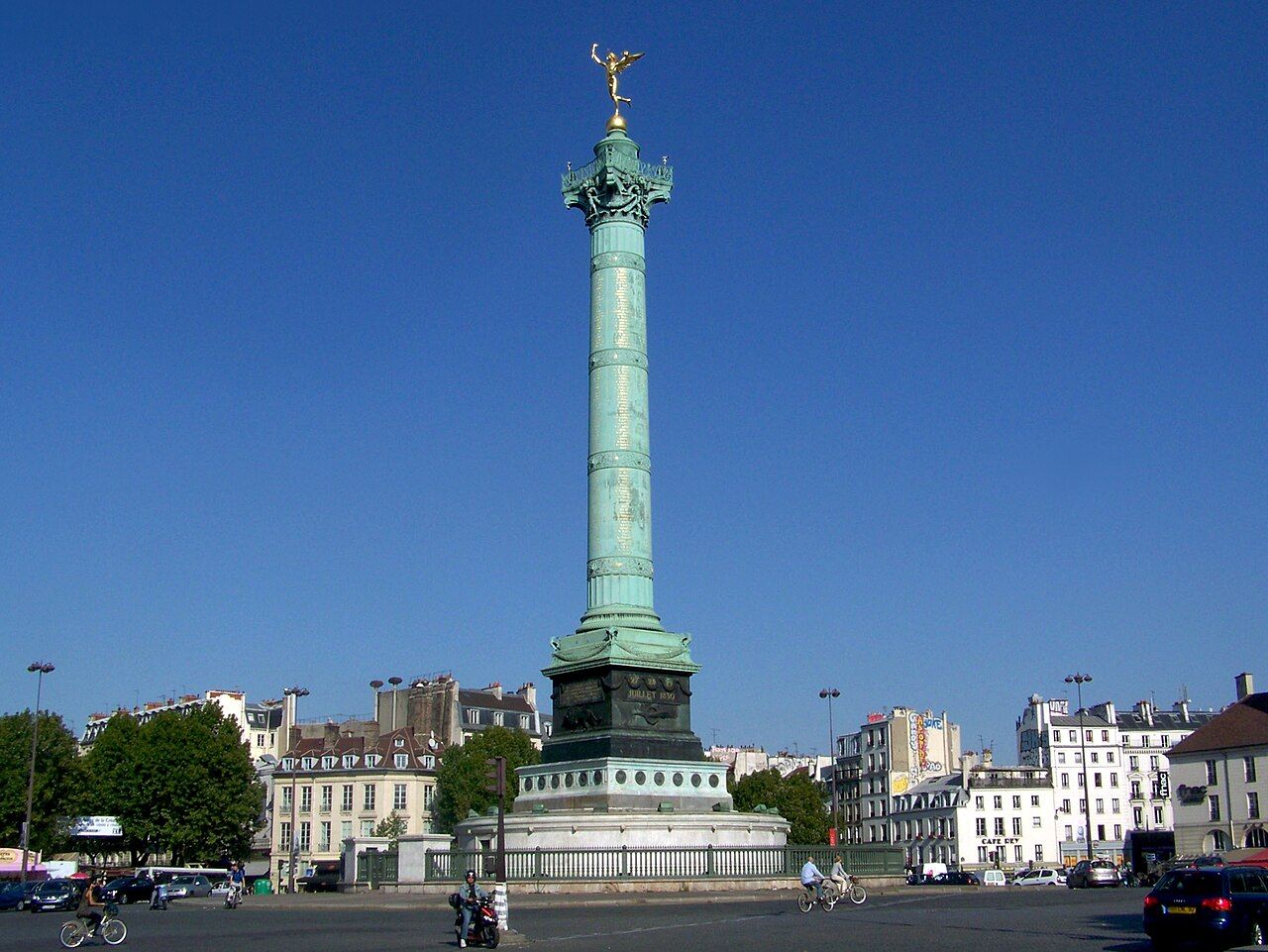
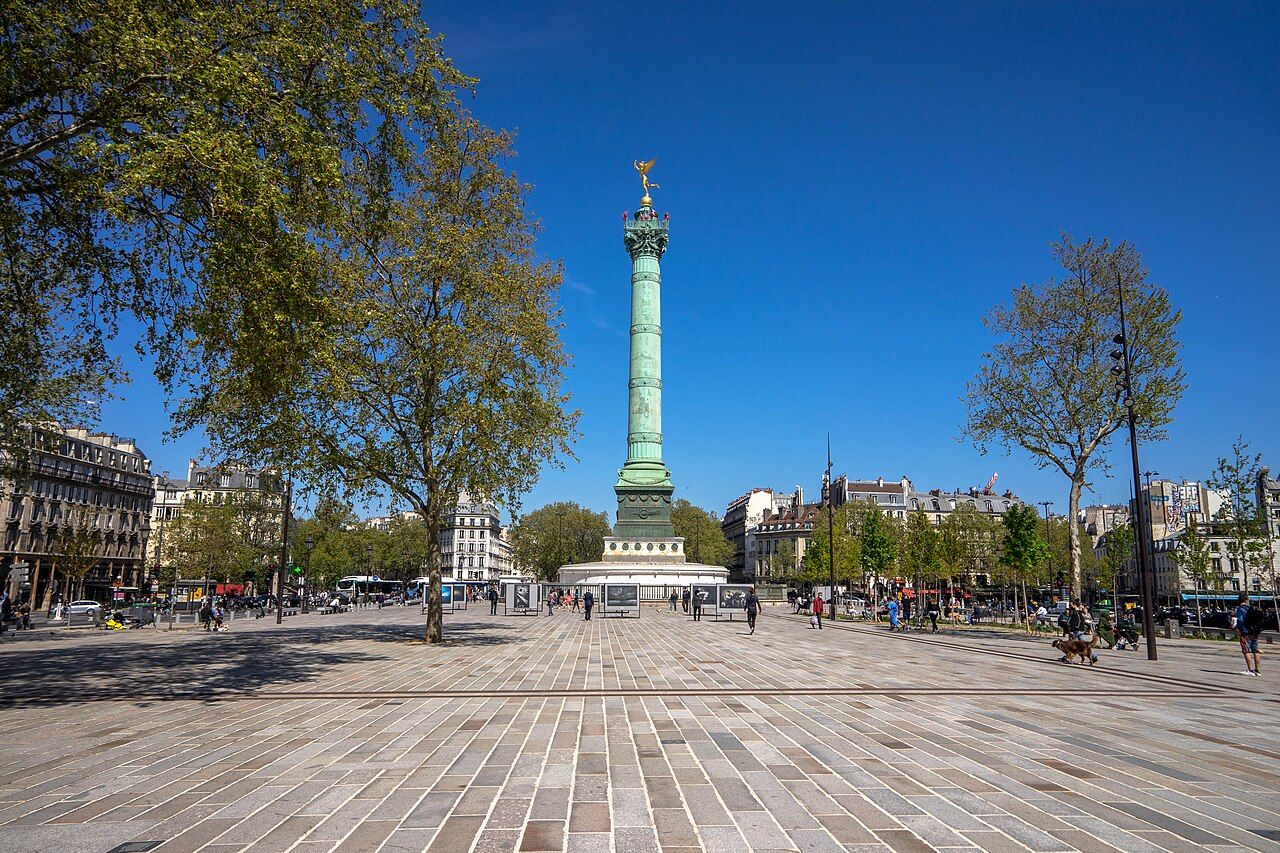
The square also carries a monument with another history. The July Column commemorates the revolution of July 1830. It does not commemorate the storming of the Bastille. That distinction is easy to blur in a place layered with upheaval.
Completed in 1840, the July Column rises about 50 metres. Its top bears the gilded Spirit of Freedom. The column belongs to a later revolution, not the fortress’s fall. Its height draws the eye upward; the Bastille’s traces remain underfoot.
That contrast makes the square’s history unusually physical. One story rises in bronze and gilding. Another survives in paving, foundations and wall fragments. The Bastille leaves no standing fortress to dominate the view. Instead, its vanished shape keeps appearing at ground level.
Late afternoon settles over stones that no longer defend anything. The outline waits among the paving lines. Beneath the square, the fortress remains a measured absence. Its walls are gone, but the edge still holds.